
What’s Next after Sequential Intercepts Model Mapping: Technology Solutions for Interagency Partners
.png) When communities adopt a coordinated data collection plan across Sequential Intercepts, they gain essential insights on community need and service efficiency. Yet, many communities lack the data infrastructure needed to track progress, monitor implementation, and inform ongoing decision-making. Without dedicated data infrastructure, practitioners often find themselves asking a familiar question after the mapping process concludes: “What’s next?”
When communities adopt a coordinated data collection plan across Sequential Intercepts, they gain essential insights on community need and service efficiency. Yet, many communities lack the data infrastructure needed to track progress, monitor implementation, and inform ongoing decision-making. Without dedicated data infrastructure, practitioners often find themselves asking a familiar question after the mapping process concludes: “What’s next?”
Brief Background: What Are Justice-Behavioral Health Intercepts
Over the past two decades, the Sequential Intercept Model (SIM) has become one of the most widely used frameworks for helping communities understand how individuals with behavioral health needs interact with crisis, health, and justice systems. The Sequential Intercept Model (SIM) is a framework that identifies key points (“intercepts”) where people with mental illness or substance use disorders can come into contact with or be diverted away from deeper involvement in the criminal justice system.
Sequential Intercept Mapping workshops bring together stakeholders across systems (justice, health, courts, probation, community services) to map how people flow through these intercepts, identify gaps, and plan interventions.
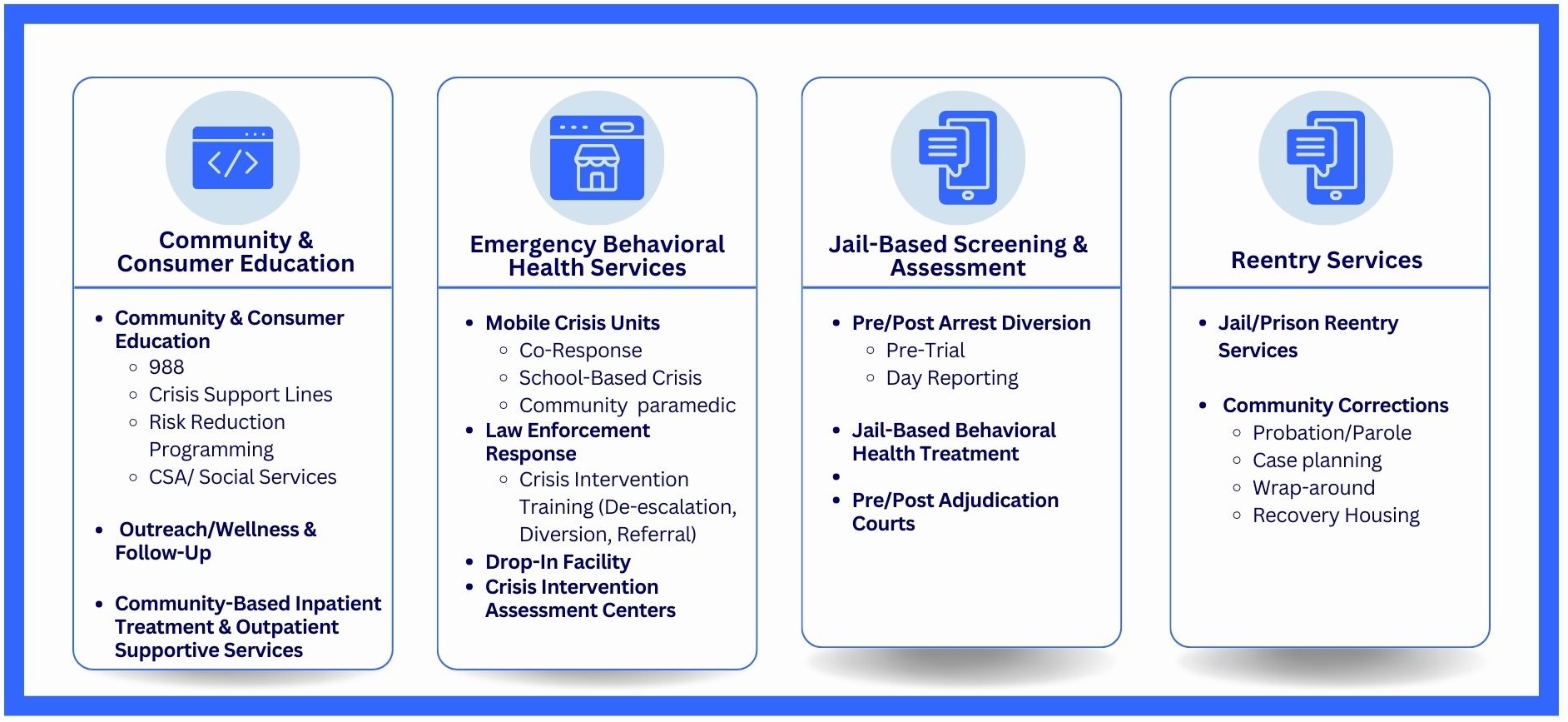 The concept was developed by researchers at Policy Research Associates (PRA), including Mark Munetz and Patricia Griffin (2006). Today, Policy Research Associates Systems Mapping and Training Center (SMTC) provides several distinct mapping approaches designed to help communities understand how people move through complex service systems including Homeless Response Systems and Crisis Intercepts Mapping. In 2025, PRA reported having facilitated over 400 mapping workshops across the United States. Moreover, additional mapping efforts occur through state‑supported initiatives and partnerships with agencies such as the SAMHSA GAINS Center.
Communities that participate in a SIM mapping typically leave with a set of concrete products and shared outputs. These outputs help communities translate the mapping exercise into actionable planning and ongoing systems improvement, which can translate into new local community response services. Mapping has been groundbreaking in helping stakeholders identify system gaps and opportunities for collaboration.
SIM Outcomes
One of the most important outcomes of a Sequential Intercept Model (SIM) mapping process is the development of a shared systems language among stakeholders. The intercept framework provides a common way for participants to describe how individuals with behavioral health needs interact with crisis response, law enforcement, courts, corrections, treatment providers, and community services. The SIM framework helps bridge these differences by establishing a consistent structure for discussing system pathways, intervention points, and opportunities for diversion or support. As a result, communities frequently identify the need to track indicators such as service referrals, diversion outcomes, program utilization, and transitions between justice and behavioral health systems. These priorities help inform the development of performance and reporting structures.
Practitioners can leave the process with a clearer understanding of system challenges and potential reforms needed, but fewer tools for operationalizing those insights. Moreover, emerging programs may lack the data infrastructure needed to track their progress, monitor implementation, and inform ongoing decision-making. Without a dedicated data infrastructure, practitioners often find themselves asking a familiar question after the mapping process concludes: "What’s next?”
Why Interagency Data Systems Are Essential at Each Intercept
When designed with strong ethical governance and privacy protections, these systems allow communities to better understand who is entering the system, where interventions occur, how services are used, and whether reforms are improving outcomes. In this way, interagency data infrastructure becomes a critical component for translating SIM mapping insights into sustained systems improvement, accountability, and evidence-based decision-making.
- To coordinate service to the appropriate and least restrictive community-based support
- To track how many people are coming into the system, where they enter, how long they stay, how frequently they use services, and what services they receive (or don’t).
- To support reporting requirements for funders, for accountability, and to justify resources.
- To enable cross-system integration: e.g. behavioral health, courts, probation, jail, and reentry agencies sharing data securely.
Core Interagency Data System Features Needed
A central component of this framework is interagency data governance, which guides the responsible collection and sharing of consumer PII/PHI and oversees regulatory compliance in storage, use and disclosure.
While many data integration initiatives emphasize large-scale data merging or universal interoperability across agencies, these approaches raise significant concerns related to privacy, consent, and the potential misuse of sensitive information. An ethical data governance approach places privacy, confidentiality, and informed consent at the center of system design. As a result, responsible interagency data governance needs to emphasize the use of de-identified, aggregated, or privacy-preserving data structures that allow communities to analyze trends and evaluate programs without unnecessarily exposing personally identifiable information.
What You Can Do
Ready to turn your mapping insights into actionable solutions involving real-time decision-making and impact assessment? Connect with our team at #ARETGroup to explore how our AI-enhanced, evidence-driven solutions can strengthen your community programs and support measurable outcomes across agencies.