
Real-World Evidence (RWE): Privacy-First Systems for Governance, Compliance and Ethical Data Use
.png)
There is a significant gap in real-world evidence (RWE) supporting the effectiveness of many public sector and community-based programs. As a result, critical frontline initiatives often lag in building a data-driven evidence base. To fully realize the benefits of real-world evidence, agencies must prioritize end-to-end compliance and ethical data management.
What is real-world evidence?
Established by the U.S. Food and Drug Administration under the 21st Century Cures Act, real-world evidence (RWE) is defined as clinical evidence regarding the usage, benefits, and risks of medical products derived from the analysis of real-world data (RWD). RWE is increasingly used to support regulatory decision-making, including label expansions, post-market safety surveillance, and effectiveness evaluations, with the goal of improving clinical practice and advancing medical research.
RWD consists of data relating to patient health status and/or the delivery of healthcare that are routinely collected outside of traditional randomized controlled trials. Common sources include electronic health records (EHR/EMR), administrative and claims data, disease and product registries, digital health technologies, and patient-generated data (e.g., wearables, surveys, and patient-reported outcomes).
- Data relevance and reliability: Data must be appropriate to address the research question and demonstrate completeness, accuracy, and consistency.
- Traceability and auditability: Full data lineage must be maintained, with clear documentation of data provenance, transformations, and analytic methods.
- Regulatory compliance: Adherence to privacy and data protection laws such as HIPAA and General Data Protection Regulation, including appropriate de-identification or anonymization standards.
- Fit-for-purpose study design: Pre-specified protocols, clearly defined endpoints, appropriate comparators, and mitigation of bias and confounding.
- Transparency and reproducibility: Documentation of analytic code, assumptions, and methodologies to enable replication and regulatory review.
- Data governance and quality assurance: Ongoing monitoring, validation, and quality control processes to ensure integrity throughout the data lifecycle.
When RWD is managed under research-grade controls—incorporating scientific rigor, regulatory compliance, and ethical oversight—it can be transformed into credible RWE.
Real World Evidence DNA:
· Rely on observational, real-world information streams (not experiments).
· Develop within programs, policies, or community environments.
· Governed within complex compliance, privacy and ethical constraints tailored to specific domains and specialized populations.
For many organizations, the development of real-world evidence (RWE) begins with the transformation of real-world data (RWD)—often originating from legacy systems such as electronic health records (EHR/EMR), records management systems (RMS), registries and claims management systems (CMS). This process involves complex, multi-stage workflows that demand data integration, normalization, harmonization of data fields, de-identification, and aggregation across disparate sources (Figure 1).
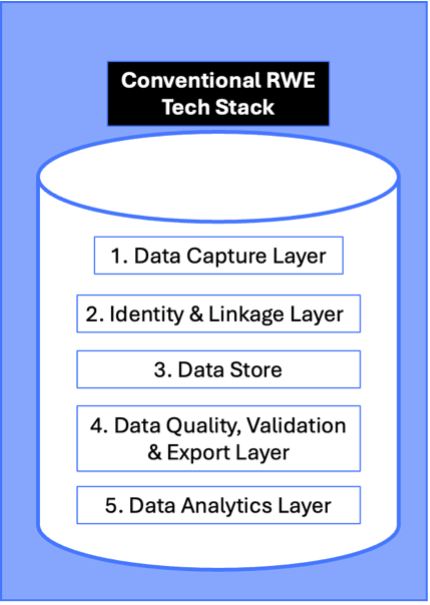
Data pipelines may traverse several layers of technology infrastructure before achieving research-grade quality. For example, raw data are ingested from source systems into a centralized data environment (e.g., a data lake or staging layer), where they are mapped to standardized data models and aligned with relevant industry frameworks and regulatory requirements. The data are then stored within structured repositories such as data warehouses, enabling access and governance.
This process is costly. Cumbersome data management layers typically lead to increased management infrastructure, added layers of technology adoption, increased risks to protected information exposure, and potential degradation in data fidelity. In most cases, RWE generation from RWD systems is an unattainable process.
As a result, there is a limited body of rigorous scientific real-world evidence evaluating the impact of programs implemented in most real-world community and public sector settings. For example, many critical, frontline care management interventions—particularly those delivered outside of controlled clinical environments—lag in establishing robust evidence bases grounded in systematic inquiry and scientific methodology.
Purpose-Built Solutions for RWE
One key emerging best practice in RWE looks to apply end-to-end electronic data capture solutions that manage processes from the point of data capture to end-stage analytics in one cohesive, automated system.
Table 1 provides a side-by-side comparison of two different RWE approaches. One relies on legacy system RWD extraction. The other offers a managed environment for collection of ethical and compliant RWD in research-grade systems.
|
Table 1. Legacy Systems Model for RWE v End-to-End RWE Solutions |
||
|
Data Source |
Fragmented, siloed legacy systems (EHRs, SIS, RMS, court records) |
EDC-enabled Interagency ecosystem for community partners, clinicians, nonprofits, families, service providers |
|
Data Collection |
Retrospective extraction, episodic snapshots |
Prospective, real-time capture, point-of-interaction entry, field-based reporting |
|
Contextual Scope |
Institution-bound, limited context |
Whole-person / whole-community view, social, behavioral, environmental factors |
|
Temporal Depth (new) |
Cross-sectional, point-in-time analysis |
Longitudinal trajectories, continuous follow-up, life-cycle tracking |
|
Processing |
Extensive cleaning and restructuring |
Structured capture at source, automated workflows, standardized inputs |
|
Data Quality (new) |
Incomplete, inconsistent, lagging indicators |
High-fidelity, traceable, audit-ready, source-verified inputs |
|
Privacy |
Post-collection de-identification |
Privacy-by-design, consent-aware, compliant EDC governance |
|
Observability (new) |
Limited to recorded institutional events |
Expanded observability, external interactions, services, and outcomes |
|
Use Case |
Retrospective analysis, reporting, analytics platforms |
Continuous learning, adaptive intervention, decision support |
|
Outcome Insight (new) |
Correlation-focused, delayed insight |
Trajectory-based insights, intervention timing, real-world effectiveness |
This approach enables a streamlined, end-to-end workflow—from first-party data collection through secure linkage, to analytics and visualization and the controlled generation and export of clinical evidence.
Conclusion: Data integrity, privacy, and regulatory compliance
While this may sound complex, end-to-end solutions reduce the technical and operational barriers to RWE access. As a result, programs and agencies in the public sector are better positioned to expand the scope, timeliness, and granularity of data capture—enabling the generation of more comprehensive, longitudinal, and high-resolution insights. Rather than spending months to years cleaning and reconciling data, programs are using platforms like ARETGroup to advance RWE in just a few short weeks.
Improving your data infrastructure and adopting evidence-based frameworks are essential goals for our company. ARETGroup is a lightweight, low‑friction SaaS platform that helps teams collect, manage, and share RWD compliantly and ethically, with access to embedded AI‑assisted and automated RWE tools. ARETGroup supports the quick set-up of a regulatory-grade data capture and evidence system.
Contact us to learn more about ARETGroup RWE technology solutions. Visit aretgroup.com
#ARETGroup #Evidence-DrivenSolutions #Real-World Evidence #Privacy-First Data Systems #End-to-End Compliance #Ethical Data Governance #Program Evaluation