
Advancing Rural Health Transformation with Offline Technology
.png) Rural health transformation requires modern digital infrastructure designed to reach America’s most vulnerable populations. Offline-capable electronic data capture offers a promising solution as an added layer of operational resiliency and interoperability. Can your data system can ensure connectivity to essential workflow elements when the internet is not connected?
Rural health transformation requires modern digital infrastructure designed to reach America’s most vulnerable populations. Offline-capable electronic data capture offers a promising solution as an added layer of operational resiliency and interoperability. Can your data system can ensure connectivity to essential workflow elements when the internet is not connected?
Introduction
A significant portion of the population remains without a household internet connection. For example, an estimate made in 2023 found that 12% of people in the U.S. lived in households without any Internet connection, according to the National Telecommunications and Information Administration (NTIA, 2023). That’s roughly 1 in 8 people. Especially, specific sub-groups are isolated at an even higher rate. For example, rural populations are some of the most affected by connectivity challenges and are commonly the most vulnerable experiencing deficits in health and social determinants of health. At the same time, implementation environments remain unevenly connected. An HHS/HRSA-funded national study found that 94% of Americans lived within a 30-minute drive-time of an HRSA-supported health center; among those outside that drive-time, 11.7 million people (60.11%) were in rural areas and more than 1.5 million households (20.32%) lacked broadband internet access.
When working in the remote and rural areas, internet reliance creates a potential point of failure for community response and other field-based operations. It is important to note, even in field-based settings with internet access, systematic data collection can fail. For example, A 2025 study of a mobile clinic serving approximately 600 migrant farmworkers and their families annually in a connectivity-challenged rural area of southern Georgia used satellite internet to enable real-time electronic medical record (EMR) data entry. Researchers here reported that backup paper forms were crucial during connectivity disruptions, demonstrating that even a mobile care model equipped with satellite broadband could not assume uninterrupted connectivity in the field (Smith et al., 2025). This underscores the importance of initiatives aimed at transforming rural health access with use of offline data capture technologies.
In conjunction with implementation of more mobile and interoperable data systems, federal and state agencies have increasingly emphasized mobile health, individual-level data collection, interoperability, and electronic information exchange as key assets for modern, real-world data infrastructure. For example, NIH has supported research involving mobile health and EHR integration and standardized data exchange, while the Centers for Medicare & Medicaid Services (CMS) has advanced national interoperability initiatives centered on FHIR and other forms of digital health modernization.
This article provides an overview of offline capable system features and benefits for real-world resiliency and interoperability in rural health outreach. Whether you are managing direct services, conducting assessments, surveying, or recording field contacts, offline access is a mission critical consideration. At ARETGroup, we are excited about the potential for impact offline systems have in expanding reach and access. Our own service, ARETGroup Horizon offers offline access as an additional layer of operational resiliency and interoperability for difficult to reach, rural and vulnerable populations when seeking to use a validated data system.
Defining Offline Electronic Data Capture
Offline-capable electronic data collection allows entry, collection and storage of information on data management systems without connection to the internet. With offline access, data are first stored locally, when connectivity is restored controlled or automatic synchronization occurs. In other words, users can ‘collect data now and sync it later.’
As a helpful distinction, offline-first systems are designed to allow applications to remain functional without an internet connection as a default and to synchronize automatically when connectivity becomes available. Offline-capable data systems are designed to maintain defined data-capture and workflow functionality when network connectivity is unavailable, while preserving the system's established security, data-integrity, and governance controls throughout the offline-to-online workflow. Offline-capable data systems work in a somewhat limited or focused way to ensure specific access fallback for periods when connectivity is unavailable. This approach can be particularly appropriate for validated EDC, clinical research, regulated data collection, and inter-agency environments, where organizations must balance field usability with requirements for data integrity, auditability, security.
A key question here is, can your data system can ensure connectivity to your essential workflow elements when the internet is unavailable?
Advantages to Using Offline-Capable Systems for Rural Health Modernization
Offline-capable electronic data capture systems have growing alignment with federal and state priorities for rural health systems modernization across many areas of field work and coordinated community response. Here are some of the key advantages, and common features, sites need to look for in offline-capable systems:
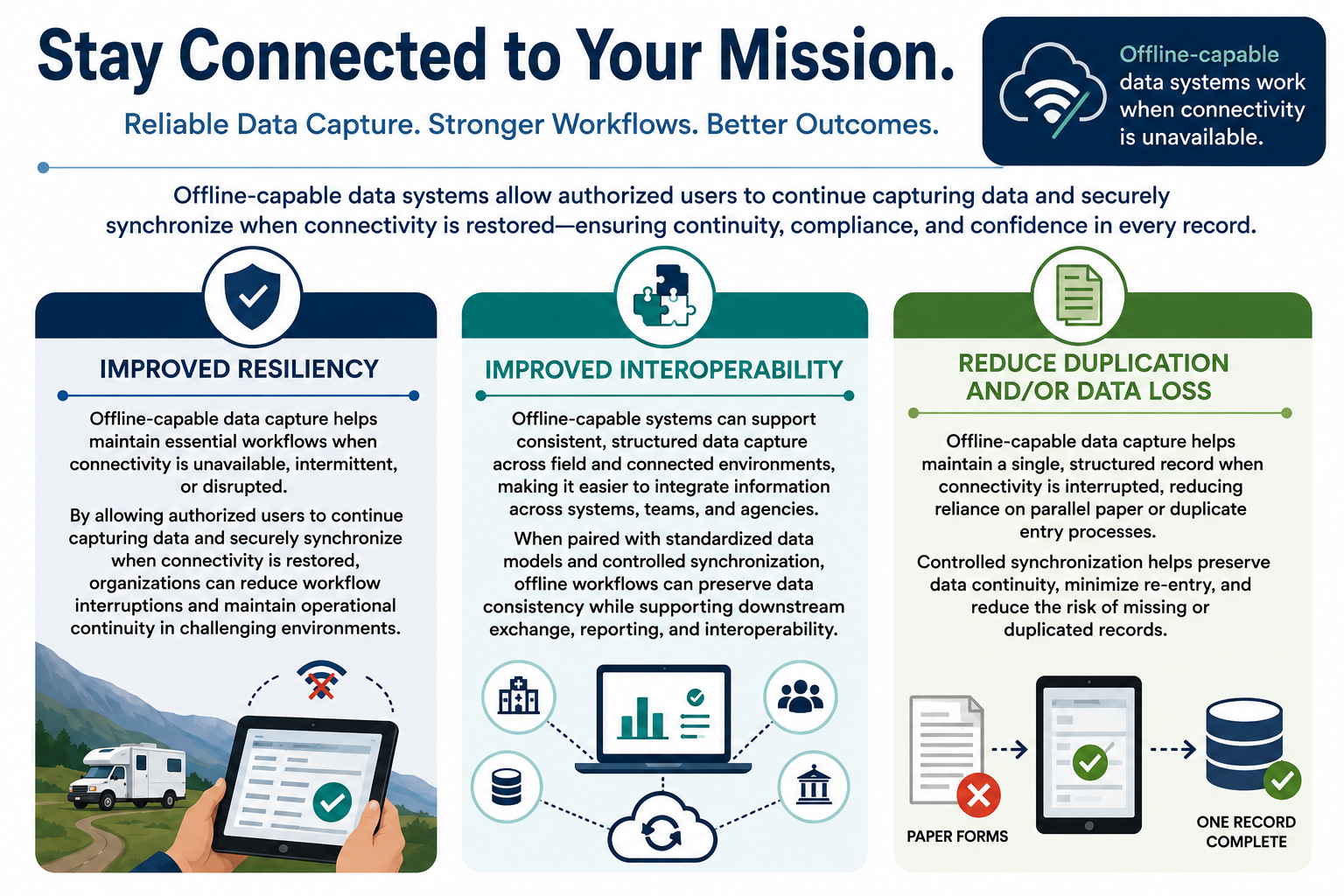 Enhanced Service Delivery. Teams observe environmental changes, evolving conditions, emerging risks and other factors that can affect public health and public safety while responding in the field, but those observations can be lost back at the office. For example, a 2026 mixed-methods feasibility study of an offline-first electronic health record (EHR) used in clinics serving displaced and rural populations found that the system was feasible to implement in low-resource community healthcare settings. The study also found that implementation enhanced clinical documentation, reduced medical errors, and supported improved patient care through medication and disease tracking (Ashista et al., 2026). Access to assessment while offline is important to ensuring that warm hand-offs, timely referrals, and more informed contacts happen in real-time.
Improved Resiliency
Most field-based contacts occur in residential homes and in communities where, commonly, connectivity in the field is unstable or unavailable. Offline capacity may allow for a more resilient system of care.
Interoperability
Offline-capable data capture helps teams maintain essential workflows when connectivity is unavailable, intermittent, or disrupted. Allowing users to continue capturing essential records makes it easier to integrate information across systems, teams, or agencies.
Reduced Duplication and Data Loss
Offline-capable data capture and controlled synchronization can help preserve data continuity, minimize re-entry, and reduce the risk of missing or duplicated records. Reducing reliance on parallel paper or duplicate entry processes saves time and resources.
Key Features
Using offline-capable electronic data capture platform can support mission critical field work in rural and remote. When seeking tools for modernization, resiliency and connectivity, ARETGroup Horizon offline systems can be a competitive solution. ARETGroup Horizon is an offline-capable data capture system with a robust model for compliant and secure offline data management. This includes the following core features:
1) Offline data capture with validation at the point of entry;
2) Conflict detection and resolution;
3) Controlled Synchronization capability;
4) Role-Based Access;
5) Internal Controls;
6) Data Audits;
7) Access to Comprehensive features and tools (e.g. Case management, Survey Management for PRO and COA; Dashboards, and Project Websites).
Conclusions
Initiatives framed around rural health transformation will provide localities and regional networks with an opportunity to extend digital care and data collection beyond traditional facilities. Offline-capable electronic data capture can offer transformative resiliency and connectivity for America’s most isolated communities. Validated electronic data capture systems, with secure offline capacity, offer are an important resource for programs serving rural areas. If field work and outreach are an essential part of what you do, ARETGroup Horizon offers modern capabilities for offline data capture.
.